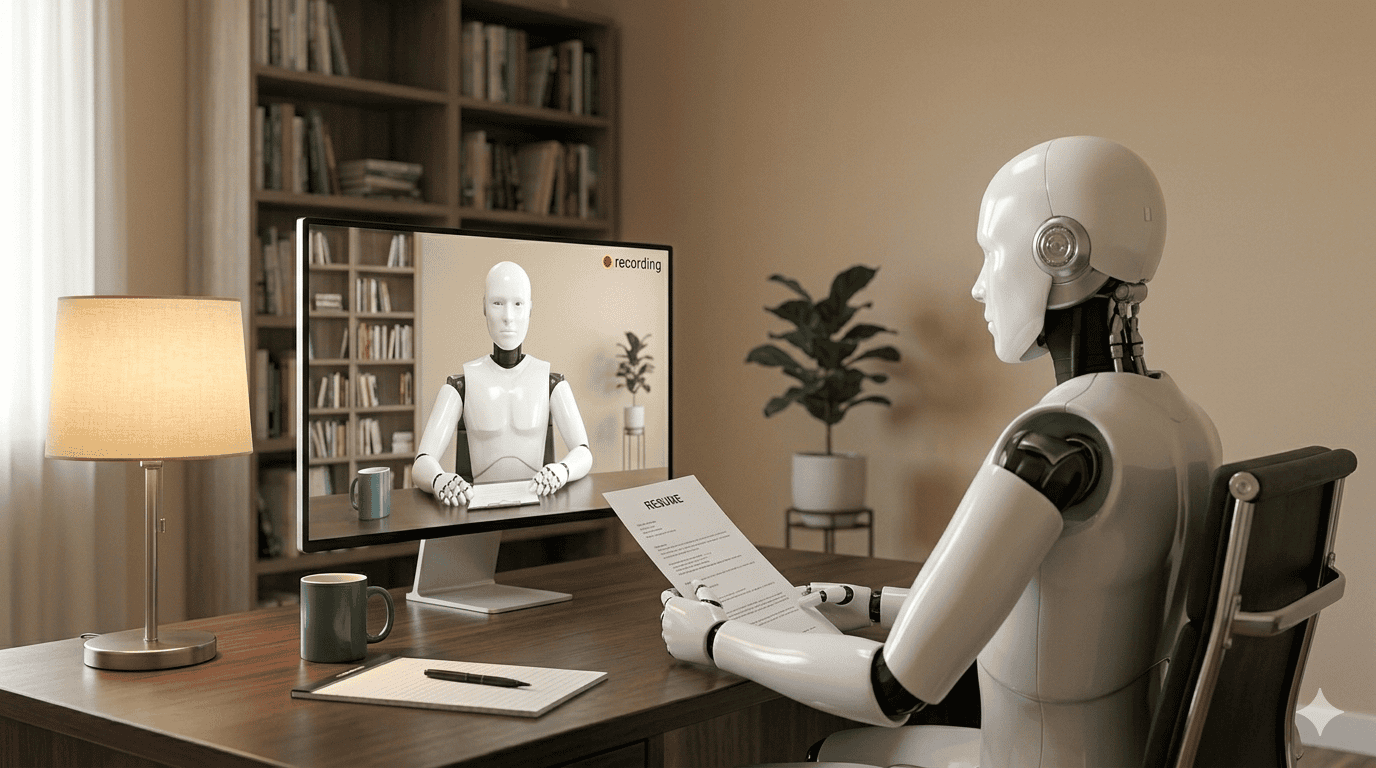
AI hiring technology is caught in an arms race it cannot win. Here is why the model is broken, what it should actually be used for, and what needs to be built instead.
Walk the floor at Unleash or HR Tech and you will find hundreds of vendors all selling some version of the same thing. AI-powered candidate matching. Smarter screening. Faster shortlists. Better fit scores. The pitches are polished, the demos are impressive, and the underlying assumption is identical across nearly every booth: AI will solve the hiring problem by finding the right person faster.
It is time to say clearly what most people in this industry are dancing around. That assumption is wrong. Not slightly miscalibrated. Structurally wrong. And the vendors who do not recognize it are not competing for market share. They are competing for the last seats on a sinking ship.
The tools designed to find the best candidates are now being used by candidates to become whoever the tools are looking for.
The Arms Race Nobody Planned For
When AI matching technology arrived, it promised a genuine signal advantage. Parse more resumes faster. Identify patterns of success that human reviewers miss. Screen at scale without bias. The pitch made sense in a world where candidates were still writing their own applications, describing their own experience, and sitting for interviews without assistance.
That world no longer exists.
Candidates have adopted the same category of tools. They use AI to rewrite their resumes against job descriptions. They use AI to generate cover letters optimized for applicant tracking systems. They use AI coaches to prepare for interviews, generate ideal answers in real time, and present a version of themselves that is calibrated to pass whatever screen is in front of them. The technology is widely available, inexpensive, and increasingly sophisticated.
Companies responded by deploying AI detection in interviews. Candidates responded by developing AI that evades detection. Companies are now building better detection. The cycle continues. At every iteration, the signal degrades further.
What you are left with is AI talking to AI. The resume that passes the screen was written by a model. The interview performance that clears the threshold was coached by a model. The score that lands someone on the shortlist was generated by a model evaluating output from another model. There is no human signal left in the process. Every match is technically perfect. Every match is also essentially meaningless.
This Is Not a Feature Problem
The instinct in the vendor community is to treat this as a solvable product challenge. Add a new detection layer. Weight behavioral signals differently. Build a better rubric. Develop a more sophisticated scoring model. These are reasonable responses to a product problem.
This is not a product problem.
The fundamental architecture of AI-to-human hiring has been broken by the same force that created it. When both sides of a matching process use equivalent tools to optimize for each other, the outcome is not a better match. The outcome is a performance. Both parties present AI-generated signals to AI-generated evaluations, and the company hires whoever has the better AI, not whoever can actually do the job.
More features do not fix this. A better algorithm does not fix this. The model itself is broken.
Hundreds of vendors are fighting for a shrinking market with marginally different features on top of a fundamentally flawed architecture.
And the market is shrinking. Hiring volumes have declined sharply and will continue to decline as enterprises deploy AI agents to handle work that previously required human headcount. The total addressable market for AI-powered human hiring is not growing. It is contracting, and it will keep contracting. The vendors who recognize this early will pivot. The ones who do not will discover it when it is too late to matter.
AI Should Be Used to Hire AI
Here is the part of this conversation that almost nobody is having openly.
AI matching technology works perfectly when you use it to hire AI agents. There is no adversarial dynamic. An AI agent does not game the screening process. It does not use a separate AI to optimize its application. It presents its actual capabilities, its actual integrations, its actual performance history. The signal is clean. The match is real. The infrastructure built over the last decade for AI-powered hiring is genuinely well-suited to this use case.
As enterprises build out multi-agent workforces, they will need to search, evaluate, and deploy AI agents at scale. They will need to assess capability, verify trust, confirm compliance, and govern performance over time. This is a hiring problem. It is also an infrastructure problem that no current TA tech vendor is positioned to solve, because they built their products for humans.
The category that survives the next five years is not better human matching. It is agent hiring infrastructure. The market is real, it is growing, and it is completely unoccupied.
A Different Model for Hiring People
When companies do need to hire people, and they will, fewer of them and more selectively, the current model fails them in five distinct ways. Each failure is significant on its own. Together they compound into a process that costs more, takes longer, and produces worse outcomes the harder you optimize it.
The first failure is trust. AI-screened candidates arrive at the hiring manager's desk as strangers. There is no human vouching for them, no social proof, no context beyond what their AI-crafted application conveyed. The hiring manager has no basis for trust and has to build it from scratch, often after investing weeks in process. That is an expensive way to evaluate someone.
The second failure is culture and fit. In AI-driven hiring, culture assessment happens late. It happens after the resume clears the screen, after the AI interview, after the skills assessment, often in the final rounds. At that point the company has already invested significantly. If the candidate is not a cultural fit, the process starts over. The cost is not just time. It is organizational energy, manager attention, and opportunity cost.
The third failure is the push dynamic. When candidates know AI is screening applications, rational behavior is to apply to everything. Volume replaces selectivity. A candidate who is marginally interested in a role applies anyway because the cost is low and the AI might say yes. Companies receive thousands of applications from people who have no genuine interest in the job. Offer declination rates are high because candidates accept interviews they never intended to convert.
The fourth failure is screening quality. AI screening optimizes for the signals it was trained on. Those signals are now generated by AI. The output is a shortlist of candidates who are good at passing AI screens, which is a different skill from being good at the job.
The fifth failure is efficiency. The combined weight of these four failures means the process is expensive at every stage and unreliable at the end.
When companies hire less, every hire matters more. The model needs to match that reality.
What Needs to Be Built
The solution to these five failures exists as a concept. What it requires is the will to build it and the recognition that it represents a genuine departure from the current paradigm, not an improvement on it.
The model is this. When a company creates a job, before it is posted publicly, it is distributed to the company's own employees. Every employee receives the job. Every employee is invited to review it and, if they know someone who might be a fit, to share it to their personal social networks with their own endorsement attached.
The effects are immediate and compounding.
Trust is established before the candidate enters the pipeline. A real human has vouched for them. The hiring manager receives candidates with a social proof layer that no AI screen can replicate, because it requires a real person to put their name behind someone.
Culture and fit are resolved before the application is submitted. The employee sharing the job knows the culture. They know what it takes to succeed there. They will not recommend someone they do not believe is a fit, because the recommendation reflects on them. The candidate, for their part, learns about the role from someone who works there, not from a job description optimized for keyword density. They understand what they are applying for before they apply.
The push dynamic inverts to pull. The candidate is not spray-applying to hundreds of roles through an AI. They are being specifically brought to this role by someone who knows them and believes in them. They arrive already sold, to some extent, on the job. Offer declination rates drop significantly when candidates come through networks rather than job boards.
Screening becomes human and selective. An employee is not going to refer someone they do not believe in. The social capital cost of a bad referral is real. That natural filter removes the adversarial AI dynamic entirely. The people who make it through are real, vouched for, and already partially evaluated by someone with inside knowledge of both the role and the candidate.
Efficiency follows from all of the above. Fewer candidates, better qualified, already culturally pre-screened, arriving with trust already established. The process is shorter, cheaper, and more reliable at every stage.
The Obvious Question
The obvious question is why this does not already exist at scale. Employee referral programs exist. They have always outperformed every other hiring channel on quality of hire, retention, and cultural fit. The data on this is not new or contested.
The reason it does not scale is structural. Traditional referral programs depend on employees to proactively think of someone, remember to make the recommendation, navigate the referral submission process, and follow up. It is friction-heavy and passive. Most employees refer people reactively, when asked, not systematically.
The model described here is different because it is active, not passive. The job goes to the employee. The employee does not have to remember to refer someone. The distribution is automatic, the sharing is one tap, and the network effect is immediate.
Not a Dusted-Off Referral Program
At this point, most heads of TA will nod and say they already have a referral program. They do. Almost every company does. And almost no one uses it seriously.
The reason is simple: it is optional. The referral program runs alongside the job board, alongside LinkedIn, alongside the AI screening tools, alongside every other channel. It is a checkbox. It appears in an onboarding slide and in an HR policy document and almost nowhere else. It is not part of anyone's job. It is not connected to anyone's performance. It does not affect whether real work gets done.
That is the fundamental design flaw, and patching it with a better referral form or a higher referral bonus does not fix it. The incentive structure has to change at a more basic level.
What if this program was not one option among many, but the only way a real person could get hired?
Imagine a company that made a deliberate decision: we will only hire human employees through this network-driven model. No public job postings. No inbound applications from strangers filtered by AI. If you are a real person and you want to work here, a real person who already works here has to bring you in.
The effect on adoption is immediate and self-enforcing. Employees do not participate because HR encouraged them to. They participate because if they need a real colleague to help them do their job, this is the only mechanism that produces one. The incentive is not a referral bonus. The incentive is getting the help they actually need.
This also changes what the program means organizationally. It is no longer an HR initiative. It is a core operating model. Employees become active participants in building the team around them, which is how the best teams have always been built, just never at scale and never with the infrastructure to support it.
This Requires Technology That Does Not Yet Exist
None of this works with the technology that currently powers referral programs. A form field and a bonus tracker are not sufficient infrastructure for a model where this is the only hiring channel.
What this model requires is a new category of AI entirely. Not AI that screens candidates. AI that activates and orchestrates human networks at scale.
That system needs to distribute jobs intelligently across an employee base, not as a mass email but as a targeted prompt to the employees whose networks are most likely to contain the right person. It needs to make social sharing frictionless across every platform an employee uses. It needs to give employees lightweight tools to screen the people they are considering recommending, so the referral decision is informed rather than casual. It needs to track network reach and engagement without surveilling employees. It needs to present hiring managers with a pipeline that is already tagged with the trust and context that came from the referral chain. And it needs to do all of this in a way that employees actually want to use, because the model only works if participation is genuine.
That is a sophisticated technical problem. It is also a completely unoccupied market. Every current TA vendor is building tools that assume a world where candidates apply to companies. This model inverts that entirely. Companies reach into their own networks to surface candidates before a single application is submitted.
The companies that build this infrastructure will not be competing with the existing matching vendors. They will be making them irrelevant for human hiring, in the same way that the existing matching vendors are being made irrelevant by the arms race they helped create.
The TA tech vendors at the next Unleash who are still building marginally better AI matching for humans are solving for a world that is dissolving. The ones who build agent hiring infrastructure, or who build the network-activation model for human hiring, are building for the world that is actually arriving.
The matching trap is real. The exit from it is also real. It requires acknowledging that more of the same is not a strategy, and that the most important hiring technology of the next decade has not been built yet.