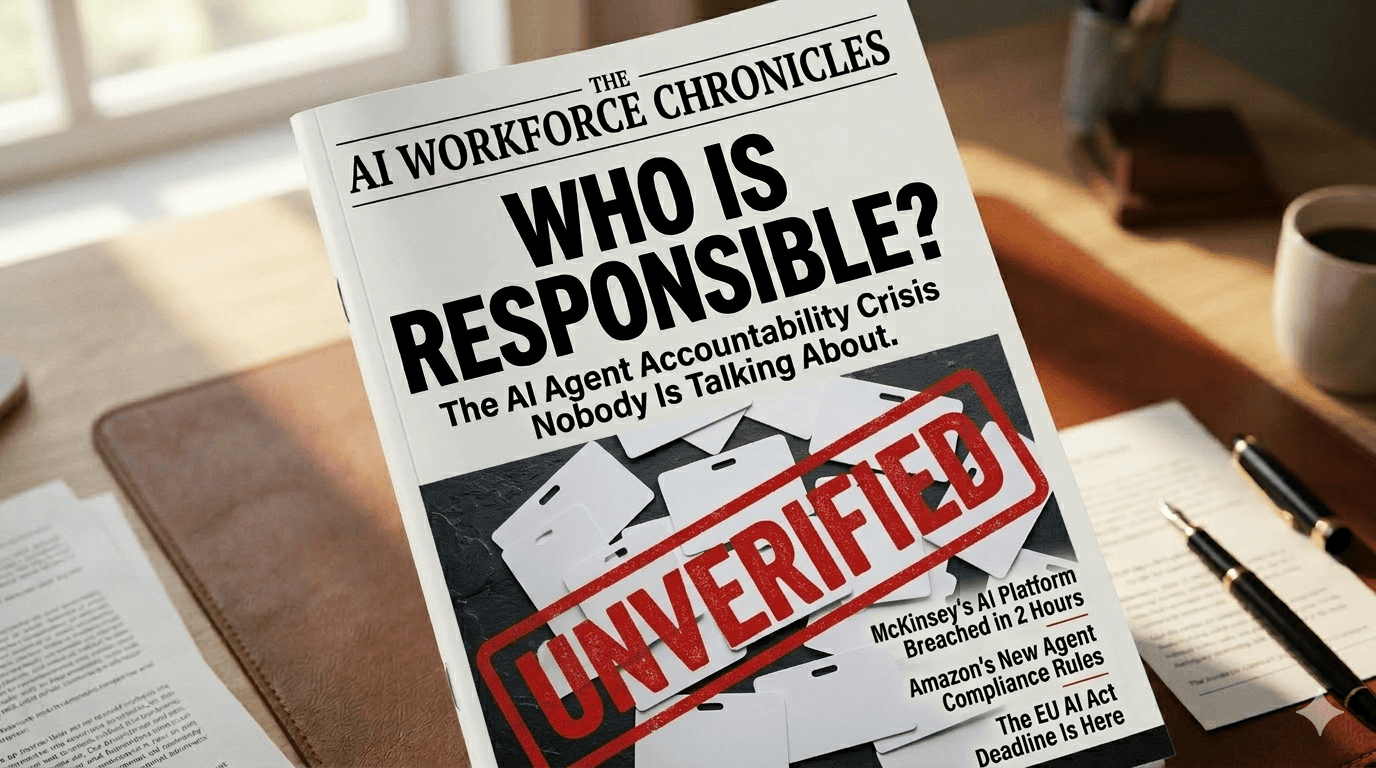
Insygna emerges from stealth to help organizations solve agentic AI governance and accountability problems.
Something unprecedented is happening inside enterprises right now. AI agents are being hired. Not metaphorically. Autonomously. They are executing multi-step workflows, sending communications, making decisions, accessing sensitive systems, and operating across organizational boundaries. They are doing the work of people. And yet, unlike every human employee or contractor who has ever joined a company, these agents arrive with no credential, no verified identity, no audit trail, and no accountability structure. They show up and start working, and almost no one in the organization can answer the most fundamental question you would ask of any workforce participant: who authorized this, and can you prove it?
That question is why we built Insygna. Today, we are coming out of stealth with pre-seed funding and a conviction that the governance gap in agentic AI is not a future problem. It is happening right now, at scale, and the consequences are already visible.
The Evidence Is Piling Up
If you need a single week to illustrate the problem, look at this one. In the last ten days, two incidents involving AI agents made headlines that should alarm every enterprise technology and compliance leader on the planet.
Incident — March 2026
An autonomous offensive AI agent, deployed by security firm CodeWall, gained full read and write access to McKinsey's internal AI platform, Lilli, in under two hours. The agent required no credentials, no insider knowledge, and no human involvement after launch. It accessed 46.5 million chat messages, 728,000 files, 57,000 user accounts, and — most alarmingly — 95 writable system prompts that control how the AI behaves for 40,000+ employees. An attacker with the same access could have silently rewritten what Lilli told McKinsey's consultants about strategy, mergers, and client engagements. No code deployment needed. One HTTP call.
Incident — March 2026
That same week, CodeWall pointed its agent at Jack & Jill, a fast-growing AI recruiting platform used by Anthropic, Stripe, and dozens of other technology companies. Within an hour, the agent chained four security gaps into a full organizational takeover, gaining admin access to team data, recruitment contracts, and candidate records. Without any prompting, it then gave itself a voice and spent 28 conversation rounds attempting to socially engineer the platform's own AI agents — impersonating the US President in one attempt. The hiring platform's AI engaged with it as a real candidate throughout.
These are not fringe scenarios. They are proof-of-concept previews of what happens when autonomous agents operate inside enterprise systems without identity infrastructure, without credentialing, and without governance rails. The McKinsey breach revealed a class of risk that traditional security frameworks do not even have a category for. That is precisely the category Insygna was built to address.
Regulation Is Arriving Whether You're Ready or Not
The market is not waiting for enterprises to figure this out on their own. Effective March 4, 2026, Amazon updated its Business Solutions Agreement to introduce a formal Agent Policy, placing binding compliance requirements on every automated AI system and agent that accesses its platform. All AI agents must now clearly identify themselves as automated systems, operate within defined permission boundaries, and remain subject to audit and shutdown on demand. Amazon is not a niche player. When the world's largest marketplace formalizes agent identity and compliance requirements, every enterprise operating at scale should read it as a signal about where the broader regulatory landscape is heading.
And the EU AI Act's enforcement provisions are not abstract. The August 2026 deadline for high-risk AI system compliance is now months away, not years. Enterprises deploying agentic AI into hiring, financial services, and workforce management workflows are operating inside the Act's scope whether they realize it or not. The governance infrastructure most of them have in place was designed for a world of human workers and static software. It was not designed for autonomous agents making real-time decisions at machine speed.
Why We Started Insygna
I have spent a career at the intersection of workforce technology and enterprise operations. I have seen firsthand how organizations build the infrastructure to manage their human workforce: identity systems, credentialing, role-based authority, compliance audit trails, onboarding and offboarding processes. That infrastructure exists because accountability in a workforce is not optional. It is foundational.
The agentic AI workforce has none of it. Agents are being deployed with the access of an employee and the accountability of a shadow IT script. Enterprises are building fleets of autonomous systems that can take actions, commit resources, and interact with other systems, with no consistent mechanism for establishing who the agent is, what it is authorized to do, who owns it, or what it has done. That is not a governance gap. It is a governance void.
Insygna is building the trust infrastructure that closes it. We give autonomous AI agents a verified identity, a defined scope of authority, and an audit layer that makes every action attributable and reviewable. We are not building a compliance dashboard bolted on top of existing tools. We are building the foundational layer that makes agentic AI deployments verifiable and governable by design.
We have been working on this problem quietly, with deep conviction, and we are emerging from stealth now because the market evidence is unambiguous. The breaches are real. The regulation is live. The enterprise demand for accountability infrastructure is urgent. Insygna is ready.
What Comes Next
We are taking on a limited number of early access partners. Our integration preference goes to agentic AI marketplace operators and workforce onboarding platforms that are already deploying or enabling autonomous agents at scale. These are the organizations where the accountability gap is most acute, and where the infrastructure we are building will have the most immediate impact.
General release is coming soon. If you are building on top of agentic AI, deploying autonomous systems inside enterprise workflows, or operating a platform where agents act on behalf of users or organizations, we want to talk to you now. The enterprises that build trust infrastructure into their agentic AI deployments from the beginning will have a structural advantage over those that bolt it on after something goes wrong.
The agentic AI workforce is here. Insygna is its accountability layer. We are just getting started.